
23,300 clicks across six months.
A single US law firm’s Google Search Console performance over a six-month engagement window. Numbers below are direct from the firm’s GSC export. Client name withheld at firm request.
23.3K
Organic
clicks
3.55M
Impressions
delivered
0.7%
Average
CTR
7.9
Average
position
Visibility without volume is invisible.
This law firm had a clean website and a reasonable Google footprint at the start of the engagement. Practice-area pages existed, the technical setup was passable, and the firm was already ranking for branded terms. The problem was reach. Impressions were a fraction of what the practice-area total addressable market actually generates.
The goal of the engagement was to lift the firm into the consideration set for non-branded practice-area queries across its geography. Not a single keyword, but the full cluster of statute, intent, and process queries a prospective client actually types into Google when they have a legal problem.
6 mo
Engagement window covered by the dashboard
1 firm
Single domain, no microsites or aggregator pages
Multi-PA
Multiple practice areas in scope, not one keyword
Google Search Console, six months.
Direct export from the firm’s GSC property. Clicks, impressions, click-through rate, and average position for the six-month window.
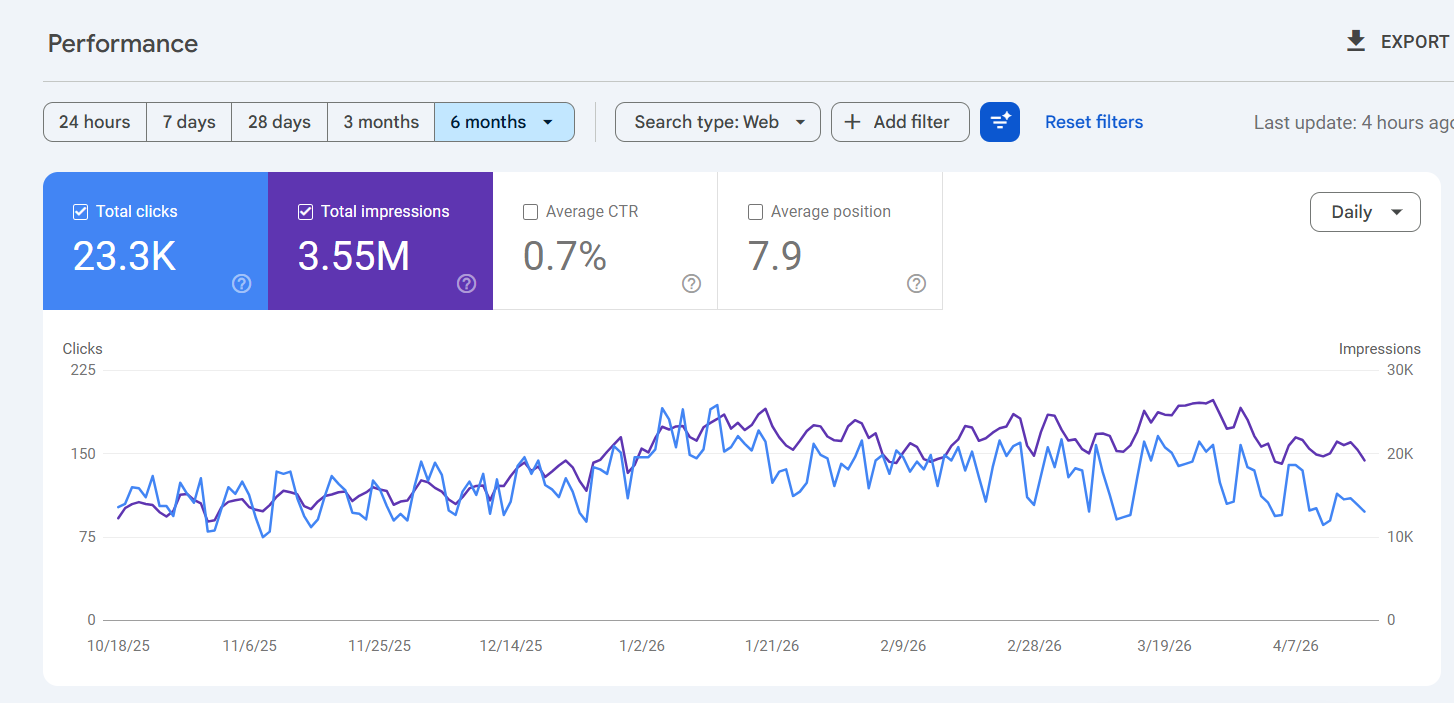
23,300
Total organic Google clicks captured across all tracked pages in the six-month dashboard window.
3.55M
Total search result impressions, indicating the breadth of practice-area visibility achieved.
0.7%
Average click-through rate, in line with positions outside the top 3 for legal-vertical queries.
7.9
Average ranking position across all tracked queries, weighted by impression volume.
Cluster-led, not page-by-page.
Treating each page as a one-off ranking target stalls at average position 12 to 20. Treating practice areas as topical clusters of pillar pages, supporting articles, and statute-led references is what compounds into volume.
A practice area is not one page. It is a system of pages that mutually reinforce authority on a topic the firm actually argues in court.
Pillar plus cluster mapping
Every practice area was mapped as a pillar page (the canonical answer for the broad query) surrounded by 8 to 15 supporting pages for sub-topics, procedural questions, and statute-led references. Internal linking was authored to direct authority into the pillar.
YMYL-grade content
Statute citations, case-law references, and jurisdictional nuance written by someone with legal training rather than paraphrased from competitors. The Google quality rater guidelines reward this directly; generic SEO copy gets buried below it.
E-E-A-T author signals
Attorney author bios on every page with credentials, bar admission, and review pathway. Schema markup connecting each page to a credentialed person. The author signal moves the needle most in YMYL verticals where Google quality raters apply stricter expertise tests.
Core Web Vitals and crawl health
Render-blocking scripts cleared, LCP and INP brought into the green band, JS rendering parity verified between mobile and desktop. The technical baseline does not rank pages by itself, but a failing one caps the ceiling on everything else.
Refresh and expand cadence
Existing pages refreshed against current statute and case law on a quarterly schedule. New cluster pages added each month to fill query gaps surfaced in GSC. Compounding works because the catalog keeps growing while the existing pages stay current.
Link earning, not link buying
Authority links from state and county bar listings, legal directories that Google actually trusts, HARO and qwoted commentary, and earned editorial features. No PBN packages, no guest-post farms, no anchor manipulation that triggers spam updates 90 days later.
Six months is the floor, not the ceiling.
Six months gets a domain into the consideration set. Twelve and eighteen months are where the compounding really shows. The dashboard above is a snapshot, not a finished outcome.
Position 7.9 is a launchpad
Page-two clicks are the early dividend. The next 12 months move impression-weighted average position into the 3 to 5 band where click-through rate doubles.
Impression breadth matters
3.55 million impressions across a single firm means the cluster strategy is working. Volume now translates directly into lead flow at higher positions.
Defensible against spam updates
No PBN exposure, no thin content, no spammy anchors. Authority earned this way survives Google’s recurring spam and helpful-content updates.
Why is the client withheld?
Is 23K clicks good for a law firm in six months?
Why is average position 7.9 and not top 3?
Does this approach work for new domains?
What does the 0.7% CTR tell you?
Want a clusters-led retainer for your firm?
Start with a free audit. Practice-area gap analysis, cluster mapping, technical baseline, and a written roadmap. No template report.
Or email directly: contact@hey-ash.com