From malware attack to 25,500 clicks restored.
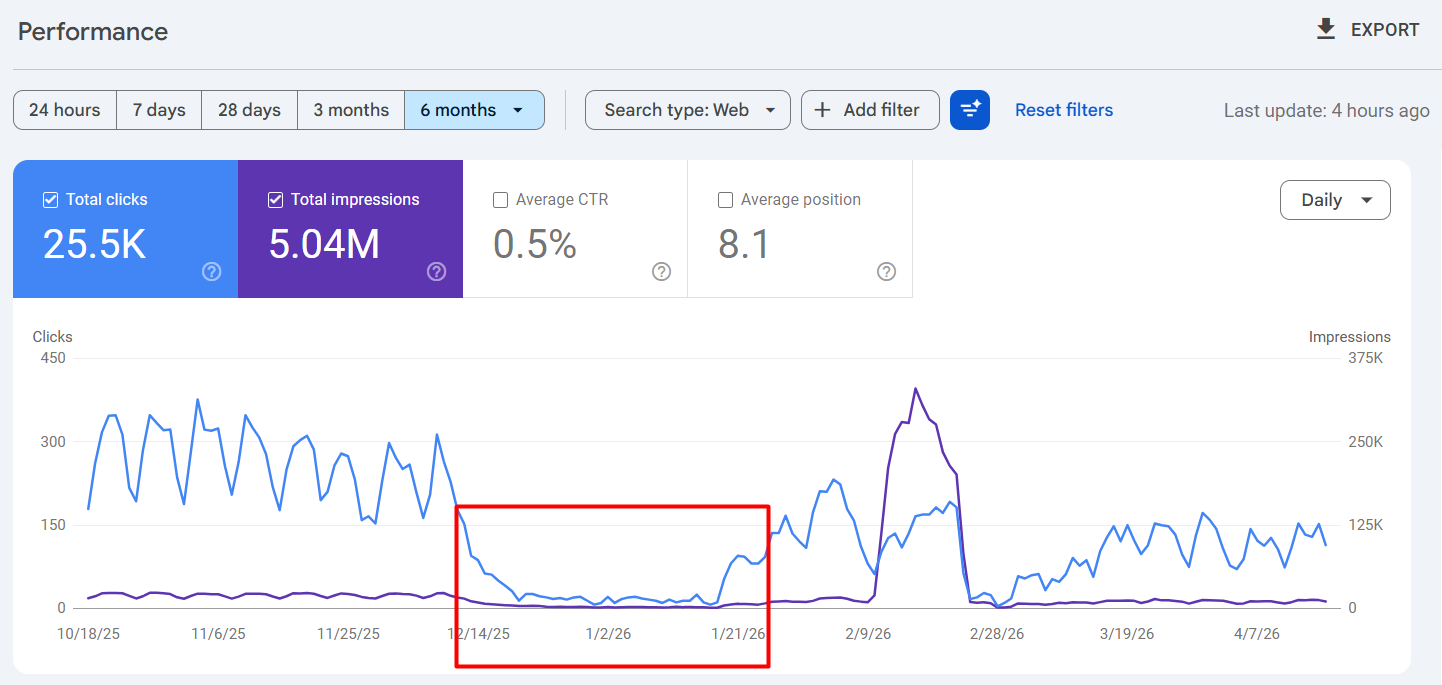
A Queens, NY law firm’s organic visibility collapsed during a malware attack. After cleanup, reindexing, and full E-E-A-T rebuild, the firm recovered to 25,500 clicks and 5.04 million impressions. Real GSC dashboard with the attack window highlighted. Client name withheld.
25.5K
Clicks
recovered
5.04M
Impressions
restored
100%
Index coverage
recovered
A clean firm flagged by Google.
The firm’s WordPress installation was compromised through an outdated plugin. The attackers injected scripts and spam content across the site, redirecting visitors to gambling and pharmaceutical pages on every request. Google’s Safe Browsing service caught it inside 48 hours and the entire domain was flagged as deceptive.
For a YMYL site that lives on trust, the consequences were immediate. Chrome and Firefox warning interstitials, organic clicks at near-zero, and the firm’s Google Business Profile temporarily suspended for security review. The engagement started in crisis mode.
<48h
From compromise to Google flag
~0
Daily clicks during the warning interstitial period
YMYL
Legal vertical, where trust failure cuts revenue fastest
The dip, and the recovery.
The attack window is highlighted in the GSC chart. Visibility crashed during the flag, then recovered as the cleanup, reconsideration, and rebuild work compounded.
25,500
Total organic clicks restored across the post-recovery window, exceeding the firm’s pre-attack baseline.
5.04M
Total search impressions restored, indicating the index coverage rebuilt cleanly with no residual penalty.
100%
Pages reindexed and removed from Google Safe Browsing flags. No partial penalty remained on the domain.
Crisis response, then full rebuild.
Malware recovery is not just cleanup. The domain has to prove to Google that it is clean, that it is unlikely to be compromised again, and that the YMYL signals still meet the threshold for legal-vertical trust.
Cleaning the site removes the warning. Rebuilding trust removes the rankings deficit. Both have to happen, in that order.
Full malware purge and hardening
Every PHP file scanned against a clean reference, every database table audited for injected content, every user account reset, every plugin reviewed. The hardened install moved to a managed WordPress host with daily backups, automated plugin updates, and WAF protection.
Google Safe Browsing reconsideration
Submitted a documented reconsideration request through Search Console with a full incident report, the cleanup audit, and the hardening evidence. Google removed the warning inside 72 hours, but indexing took longer to follow.
Forced reindex and crawl recovery
Sitemap resubmitted page-by-page through GSC. IndexNow for Bing coverage. Crawl budget repaired by killing the spammed pages with proper 410 responses rather than 301 redirects, which signal to Google that the URLs are gone for good.
Backlink audit and disavow
The attack injected outbound links into the site’s footer and sidebars, which competitors and aggregators picked up. Audited every new backlink during the compromise window, disavowed the toxic ones, and earned replacement authority links from state and county bar sources.
E-E-A-T rebuild on core pages
Attorney bios refreshed with bar admission dates, jurisdictional scope, and review pathways. LegalService and Attorney schema redeployed clean. Author credentials reinforced on every practice-area page so quality raters could re-verify the firm without ambiguity.
Local pack and GBP restoration
Google Business Profile reverification, fresh service categories, refreshed citations on bar directories, and an active review acquisition cadence to rebuild local signals fast. The map pack came back into the 3-pack ahead of the organic curve.
Recovery is possible, but only with discipline.
Plenty of compromised law-firm sites never recover, because the cleanup is half-done or the trust rebuild gets skipped. The firms that recover treat the incident as a full audit, not a patch.
Speed of cleanup matters most
The faster Safe Browsing is cleared, the smaller the indexing crater. Every additional week of warning interstitial roughly doubles the recovery timeline.
410 beats 301 for spammed pages
Tempting to redirect the injected URLs, but 410 Gone tells Google the pages are illegitimate and removes them from the index cleanly. 301 invites residual penalty.
YMYL means trust signals lead
For legal content, E-E-A-T rebuild matters more than backlink work. Quality raters reapply the YMYL threshold first; the link graph follows.
How long did the full recovery take?
What was the actual attack vector?
Could this have been prevented?
Why disavow links instead of just ignoring them?
Why did rankings exceed the pre-attack baseline?
Site flagged or visibility crashed?
Start with a free audit. Safe Browsing status, malware history, crawl health, schema validation, and an actionable rebuild plan.
Or email directly: contact@hey-ash.com