

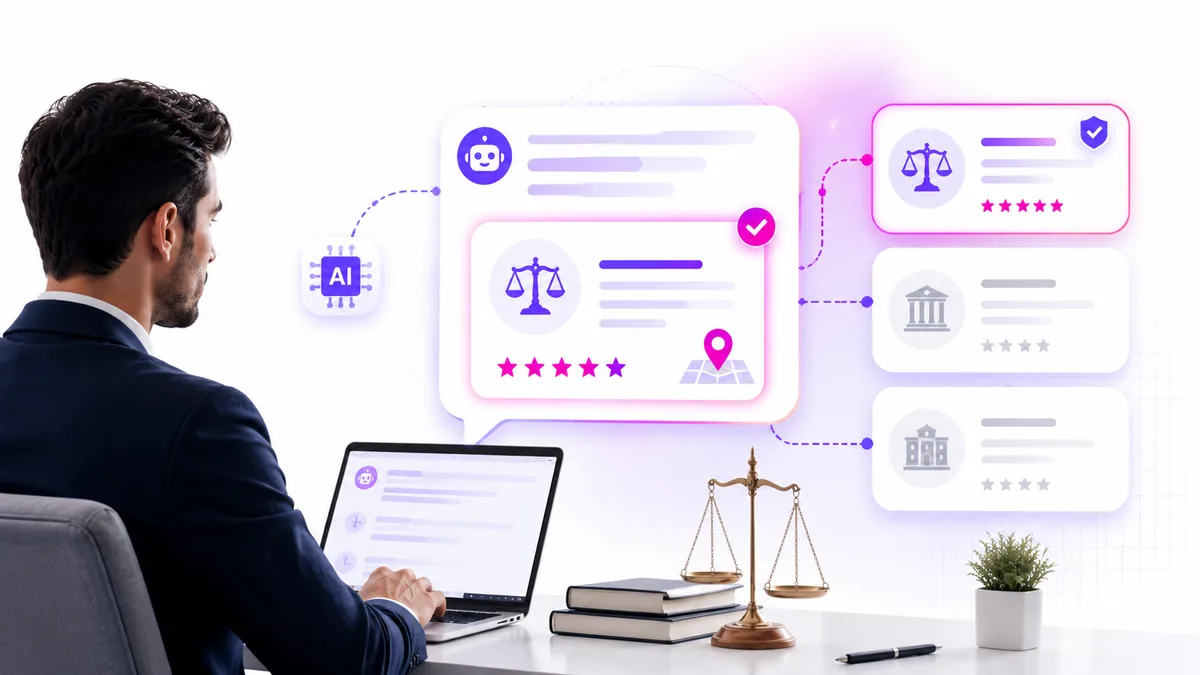
Picture the person who needs you most. They were just in a car accident, or they were served with papers, or they were fired in a way that felt wrong. A few years ago they would have opened Google and started calling firms. Today a growing share of them open ChatGPT or read Google's AI answer first, ask what their options are and who handles cases like theirs, and receive a short list of firms to trust. If your firm is not on that list, you were passed over before the phone was ever in their hand.
This is not a fringe behavior. More than three-quarters of legal searches now trigger an AI-generated answer, the highest rate of any professional field, and around 60 percent of Google searches end without a single click. A firm sitting just below the AI summary can lose most of the traffic it used to earn. The hard part to accept is that these systems do not rank your pages the way classic SEO did. They decide which sources are worth citing, and citation is a different game with different rules.
Why AI leaves your firm out
When I audit a firm that AI never mentions, the reasons are almost always the same short list. None of them are about how good the lawyers are. They are about how legible the firm is to a machine.
- Anonymous practice-area pages. Pages of legal information with no named attorney and no verifiable credentials, which these systems discount hard on legal topics.
- An inconsistent identity. The firm name, address, or attorney list differs across the website, the Google Business Profile, and directories like Avvo and Justia, so the model cannot confidently tell who you are.
- Marketing prose instead of answers. Pages that describe how aggressively you fight for clients but never actually answer the question the client typed.
- No outside footprint. Nothing beyond your own website corroborates your claims, so a cautious system has nothing to lean on.
How AI decides which firms to name
An assistant recommending a lawyer is pattern-matching on public evidence: the firm website, individual attorney profiles, the legal directories, and reviews. Research on legal AI visibility is consistent that these systems surface lawyers with third-party validation and consistent public data. Three signals decide it, and I treat them as a checklist.
- Extractable answers. Your practice-area pages answer the real question a client asks, with the answer up top in plain language a model can quote.
- A verifiable identity. Firm name, attorney names, bar admissions, and locations read the same everywhere, reinforced with Attorney, LegalService, and Person schema so the model can connect the dots.
- Corroboration. Accurate profiles on the directories these engines actually read, plus genuine reviews, so an independent source agrees with what your own site says.
The process I run on a law firm
The sequence is the same one that produced my strongest result to date, and I run it in this order because each step compounds the one before it.
- Start with the practice-area pages that already rank. I rewrite their openings so the client question is answered in the first two sentences, then keep the depth below.
- Answer the questions clients actually ask, drawn from intake calls, consultations, and reviews, then turn each one into a heading a model can match.
- Put a named attorney behind the advice. Real authorship with verifiable bar credentials and admissions, because an anonymous page of legal guidance is exactly what these systems distrust.
- Fix the identity across the web. One consistent firm identity on the site, the profile, and every legal directory, so nothing contradicts anything.
- Build honest corroboration. Genuine reviews and accurate directory listings, never fabricated testimonials, which in this field are both an SEO problem and an ethics problem.
Answer the question the client types at 11pm
Old SEO trained firms to stuff a phrase like personal injury lawyer onto a page. Generative engines do not reward that. They reward the page that genuinely resolves the worry behind the search. When I rewrite a practice-area page, I picture the exact sentence a frightened person would type late at night and make sure the page answers it more clearly than anything else the model could reach for. That is what earns the citation.
The compliance layer most SEOs miss
This is where my law background earns its place. Attorney advertising is regulated, and the rules are tightening around AI. New York became the first state to require clear disclosure when advertising content is substantially generated by AI, effective in 2026, and the FTC introduced its own AI disclosure requirement the same year. Bar guidance across states is consistent on one point: if an AI tool generates a misleading claim or omits a required disclaimer, the responsibility still belongs to the lawyer. I build a firm's AI visibility without manufacturing endorsements, without synthetic testimonials, and with the prior-results and disclosure caveats these rules expect. An SEO who does not understand attorney advertising can win you a citation and hand you an ethics problem. I hold an LL.B and an LL.M, so I keep both in view.
Want to see what AI says about your firm?
I will ask Google's AI Overview, ChatGPT, and Perplexity the questions your clients ask, capture exactly which firms get named and cited, and send you an honest read on where you stand and what to fix first.
What this looks like when it works
On one law firm project, I rebuilt the site so its expertise was easy for machines to extract and its identity was consistent across the web. Over three months, the firm earned 208,400 AI citations across Bing and Copilot, measured in Microsoft's own AI performance dashboard. It is now part of the answer whenever an assistant discusses its practice area. I do not share that number to impress you with a single result. I share it because the approach behind it is deliberately boring and repeatable: extractable expertise, a clean identity, real credentials, and honest corroboration, applied patiently. The same method is how I get any business recommended by AI.
Test where your firm stands this week
Do not guess at this. Ten honest minutes will tell you most of what you need to know.
- Write down the five questions a client asks right before they hire a firm like yours.
- Ask each one in Google and read the AI Overview. Note which firms get named and cited.
- Ask the same questions in ChatGPT and Perplexity, then ask each engine directly what it knows about your firm.
- Mark every question where a competitor appears and you do not. That is your priority order.
If the same competitors keep getting named while your firm stays invisible, that is not a cosmetic problem. In a field where AI answers now sit above the results for most searches, it is a steady leak of cases to whoever did the work first.
These systems do not rank your pages anymore. They decide which firms are worth citing, and earning that citation is now the center of law firm marketing.
The reassuring part is that the work rewards firms that deserve to win. Clear answers, verifiable credentials, a consistent identity, and honest outside validation are exactly what a reputable firm already has. My job is to make that credibility legible to the machines now standing between you and your next client, and to do it in a way that respects the rules your license depends on. If you want me to look at where your firm stands today, that is the legal SEO work I do.