

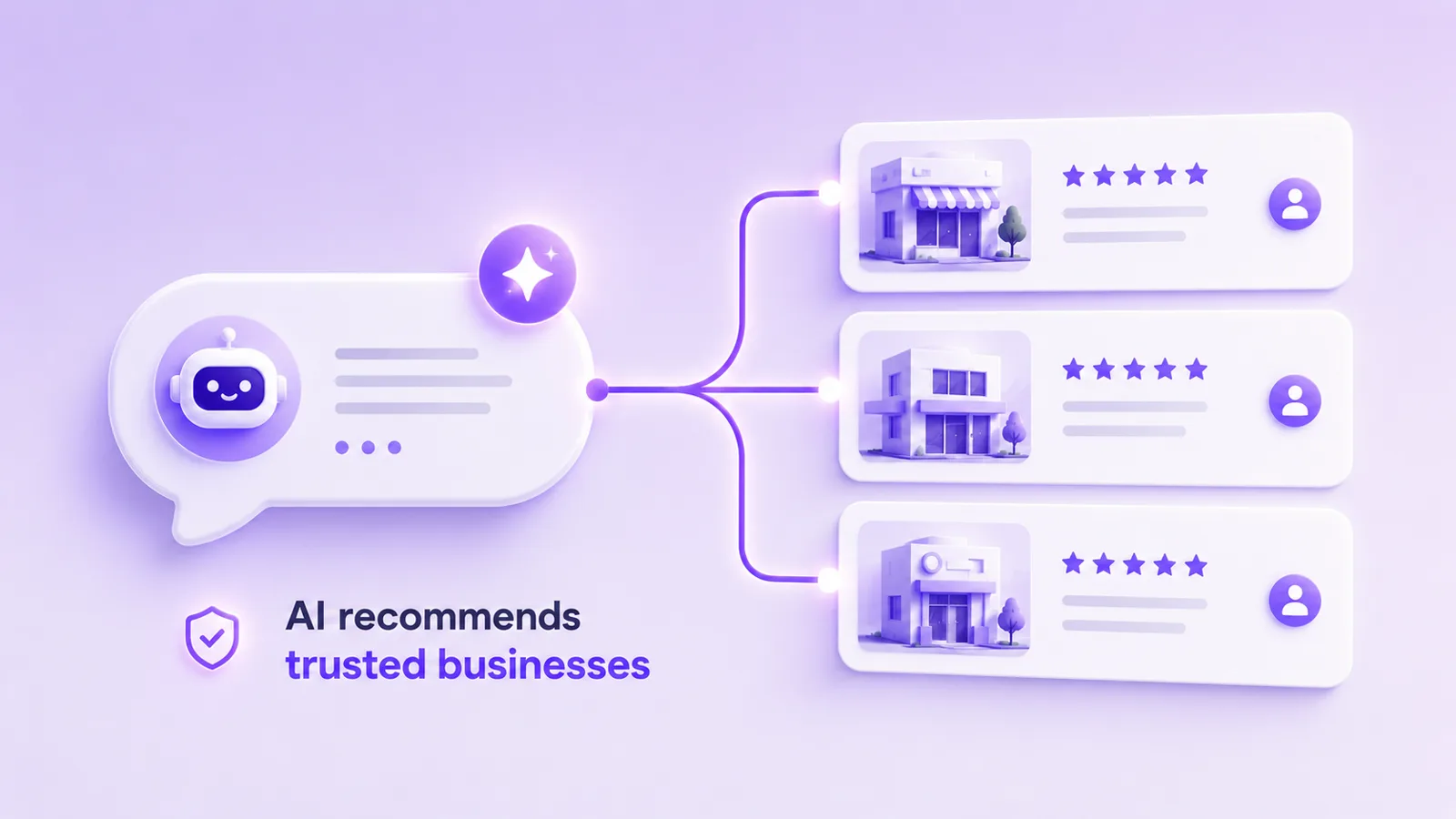
More and more, the first thing your future patient or client does is not call a friend or open Google. They open ChatGPT, Gemini, or Perplexity and ask who the good options are, what to look for, and whether a specific provider is any good. The assistant answers with a short list of names, and that list quietly decides who gets the call. I spend a large part of my week making sure my clients are on it.
The question I get asked most is simple: how do I become one of the names it gives? There is no ad slot to buy and no button that inserts you into the answer. But after doing this across a lot of sites, I can tell you the way these systems choose is far more predictable than it looks, and you can influence it on purpose.
How an assistant actually decides who to name
An AI assistant has no private opinion about your business. When it recommends, it is pattern-matching on public evidence: who is described consistently across the web, who is corroborated by independent sources, and who has content that clearly answers the question being asked. Give it that evidence in a form it can read, and you become an easy, low-risk name to include. Withhold it, and the model reaches for whoever supplied it instead.
The playbook I run on every project
This is the sequence, in the order I actually do it. Each step compounds the one before it.
- Make the expertise extractable. Every important page answers one real question, with the answer up top in plain language. Assistants quote clean, direct content and skip vague prose about being passionate and dedicated.
- Lock down the identity. Name, category, location, credentials, and services read the same everywhere, reinforced with Person, Organization, and Service schema so the model can connect the dots without guessing.
- Cover the pre-decision questions. Comparisons, costs, what to expect, how to choose, and the honest tradeoffs. These are the prompts people type, and the businesses that answer them get pulled into the response.
- Build third-party corroboration. Accurate profiles on the directories and review platforms these engines read, plus genuine mentions on industry sites. Outside agreement with your own claims is the strongest signal you can send.
- Keep it current. Models favor information that looks maintained. I review cornerstone content on a schedule and update it honestly, dates included.
Write for the question, not for the keyword
Old SEO trained people to stuff a phrase onto a page. Generative engines do not reward that. They reward a page that genuinely resolves the intent behind the question. When I rewrite a service page, I imagine the exact sentence a worried person would type at 11pm and make sure the page answers it better than anything else the model could pull. That is what earns the citation.
Want to know what AI says about you right now?
I will ask ChatGPT, Gemini, and Perplexity the questions your customers ask, capture exactly who gets recommended and cited, and send you a short, honest read on where you stand and what to fix first.
What this looks like when it works
On one law firm project, I rebuilt the site so its expertise was easy for machines to extract and its identity was consistent across the web. Over three months, the firm earned 208,400 AI citations across Bing and Copilot, measured in Microsoft's own AI performance dashboard. It is now part of the answer whenever an assistant discusses its practice area. I am not sharing that number to impress you with a single result. I am sharing it because the approach behind it is boring and repeatable: extractable expertise, a clean identity, and honest corroboration, applied patiently.
The mistakes that keep businesses invisible
When I audit a business that AI never mentions, the causes are almost always the same short list.
- Anonymous content. Pages of advice with no named, credentialed author, which these systems discount hard on health and legal topics.
- An inconsistent identity. The name or address differs across the site, the profile, and directories, so the model cannot confidently tell who you are.
- Marketing prose instead of answers. Pages that describe how committed you are but never actually answer the question a customer asked.
- No outside footprint. Nothing beyond your own website says you exist, so there is nothing to corroborate.
Check where you stand today
Do not guess at this. Open ChatGPT, Gemini, and Perplexity and ask the exact questions your customers ask, including your business by name. Notice who gets recommended, who gets cited, and what each engine says about you when asked directly. That five-minute test tells you whether you are already in the conversation or completely absent from it, and absence is a problem that compounds while the competitors who did the work keep getting named. If you would rather I run it properly and tell you what to do about it, that is exactly the kind of work I do.