

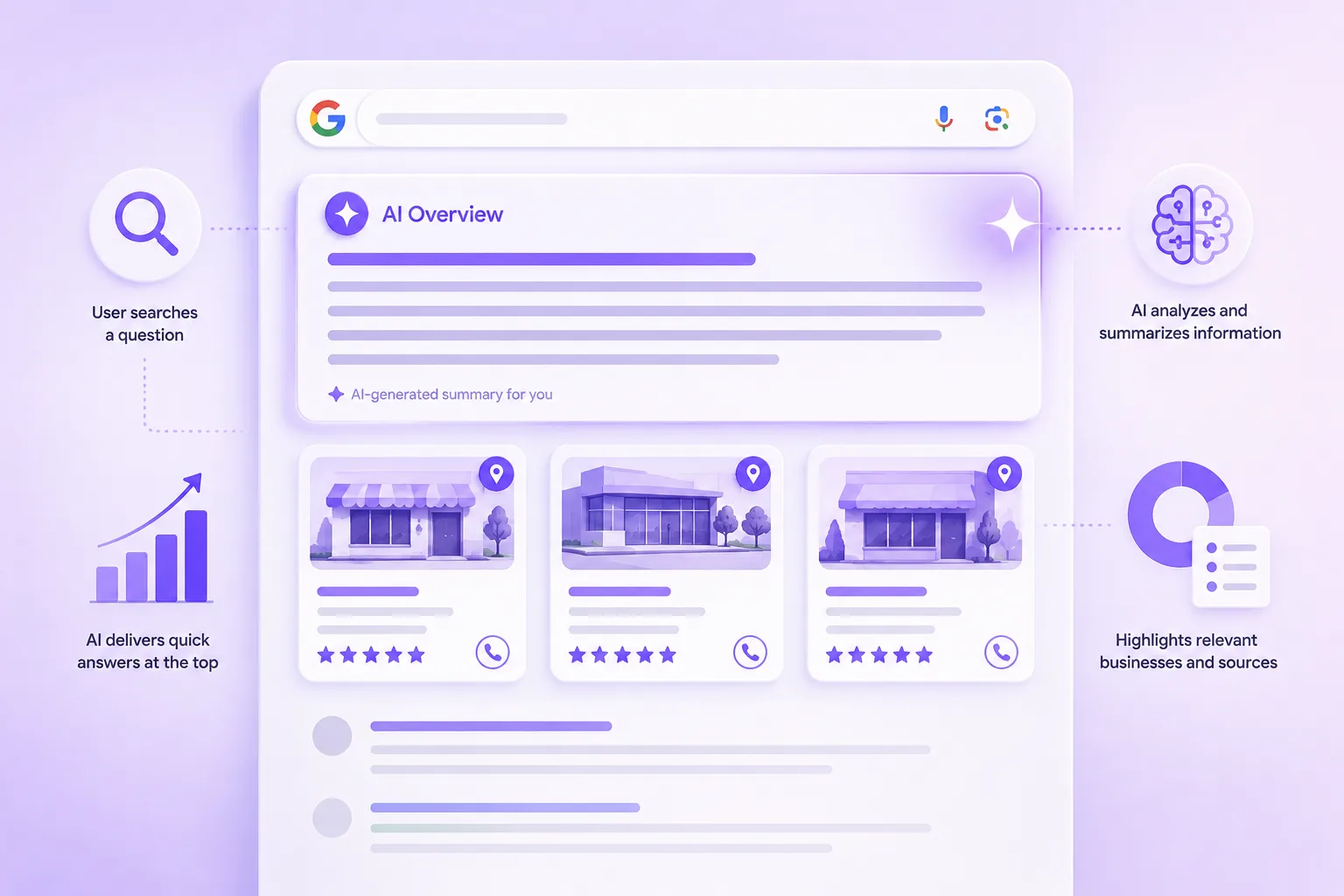
I have spent nearly a decade doing SEO, and I cannot remember a shift that rearranged the board as fast as AI Overviews did. A client can hold the number one organic position for a valuable query and still watch their clicks fall, because Google now writes an answer above the results and names a few sources inside it. Position one is still there. It is just no longer the first thing anyone reads.
For the doctors, dentists, and lawyers I work with, this is the whole ballgame. The old goal was ranking on page one. The new goal is being named inside the AI answer that sits above page one. If Google's overview recommends three cosmetic dentists in a city and my client is not one of them, the ranking they paid for is now below a summary most people never scroll past. I want to walk you through what is actually happening and the exact process I use to stay in that answer.
What an AI Overview is actually doing
An AI Overview is not a ranked list with a paragraph glued on top. It is a generated summary. Google retrieves content it considers reliable for the query, has a model write a short answer, and attaches citations to the pages that answer held up against. That distinction matters, because it changes what you are optimizing for. You are no longer only competing for a rank. You are competing to be a source the model reaches for and feels safe quoting.
In practice, three signals decide whether one of my clients makes it into that answer. I treat them as a checklist on every project.
- Extractable answers. The page states the answer to a real question in the first sentence or two, in clean prose a model can lift without guessing at your meaning.
- A single, clear identity. Name, category, location, services, and hours read the same on the site, on the Google Business Profile, and on the directories that describe the business. Ambiguity gets you left out.
- Outside corroboration. When independent sites describe you the same way, the model treats you as a safer name to put in front of a real person who is about to make a health or legal decision.
Why local and professional businesses feel this first
AI Overviews show up hardest on exactly the searches my clients live on. Nobody asks for a written summary before buying socks. People absolutely ask what to look for in an implant dentist, whether neck stiffness after a car accident needs a doctor, or who handles wrongful termination cases nearby. These are considered, higher-stakes decisions, and a summary that names a couple of trusted options is genuinely useful. That usefulness is why Google leans on overviews here more than almost anywhere else.
My law background shapes how I read this. Google has always been most cautious with what it calls Your Money or Your Life topics, the health, legal, and financial queries where bad information can genuinely harm someone. AI answers inherit that caution. The bar for being cited in a medical or legal overview is higher, which is good news if you are a real, credentialed provider and terrible news if your site reads like anonymous filler.
The process I use to get a business into AI answers
There is no button to buy your way in and no schema tag that flips a switch. What works is a sequence I run on every engagement, in this order.
- Start with the pages that already rank. They have earned trust. I rewrite their openings so the core question is answered in the first two sentences, then keep the supporting detail below.
- Turn real questions into headings. I mine the actual questions patients and clients ask, from consults, reviews, and Search Console, and answer each one plainly. These headings are what models match against.
- Fix the identity layer. One consistent name, address, phone, and service list across the site, your Google Business Profile, and the major directories, reinforced with Organization, LocalBusiness, and Person schema so machines read it without ambiguity.
- Prove the expertise. A named, credentialed author on substantive pages, with a bio that lists verifiable qualifications, because an anonymous page of medical or legal advice is exactly what these systems discount.
- Build honest corroboration. Reviews, accurate directory listings, and mentions on sites that matter in the field. One outside source that matches your own claims is worth more than ten pages of self-description.
Structure the page so a machine can quote it
The single highest-leverage change I make is boring: answer first, elaborate second. Most service pages bury the answer under a paragraph of throat-clearing about being committed to excellence. A model has to guess what that page is even claiming. When the first line says plainly what the treatment is, who it is for, and what to expect, the model can quote it, and quoting it is how you get cited.
Make your identity impossible to misread
I have lost count of the businesses I have audited where the name is slightly different on the site, the Google Business Profile, and Yelp, or the address is formatted three ways, or an old suite number lingers on a directory. Every one of those small mismatches is a reason for a cautious system to skip you. Cleaning this up is unglamorous and it is often the fastest win on the whole project.
Not sure whether you show up in AI answers?
I will run your real customer questions through Google's AI Overview, ChatGPT, and Perplexity, and tell you exactly where you are cited, where a competitor is named instead, and what I would change first.
How to check where you stand in ten minutes
You do not need a tool for a first read. You need ten honest minutes.
- Write down the five questions a customer asks right before they choose you.
- Ask each one in Google and read the AI Overview. Note who gets named and cited.
- Ask the same questions in ChatGPT and Perplexity, then ask each engine directly what it knows about your business.
- Mark every query where a competitor shows up and you do not. That list is your priority order.
If your competitors keep appearing and you keep being absent, that gap is costing you calls right now, and it widens every month it goes unaddressed. The businesses treating AI visibility as next year's problem are the ones handing this year's patients and cases to whoever did the work early.
The mindset shift for 2026
Stop measuring success only by where you rank, and start asking a blunter question: when someone asks AI about my service in my city, am I in the answer? That is the number I now report to clients first, because it is the one that maps to phones ringing.
SEO in 2026 is not about ten blue links anymore. Discovery happens inside ChatGPT, Perplexity, and Google AI Overviews, and the work that matters most is getting cited in those answers.
The reassuring part is that the work rewards the businesses that deserve to win. Clear answers, a clean identity, real credentials, and honest outside mentions are exactly what a good doctor or lawyer already has. My job is mostly to make that credibility legible to the machines now standing between you and your next patient. Do that, and you get found in both the old rankings and the new answers at once.