
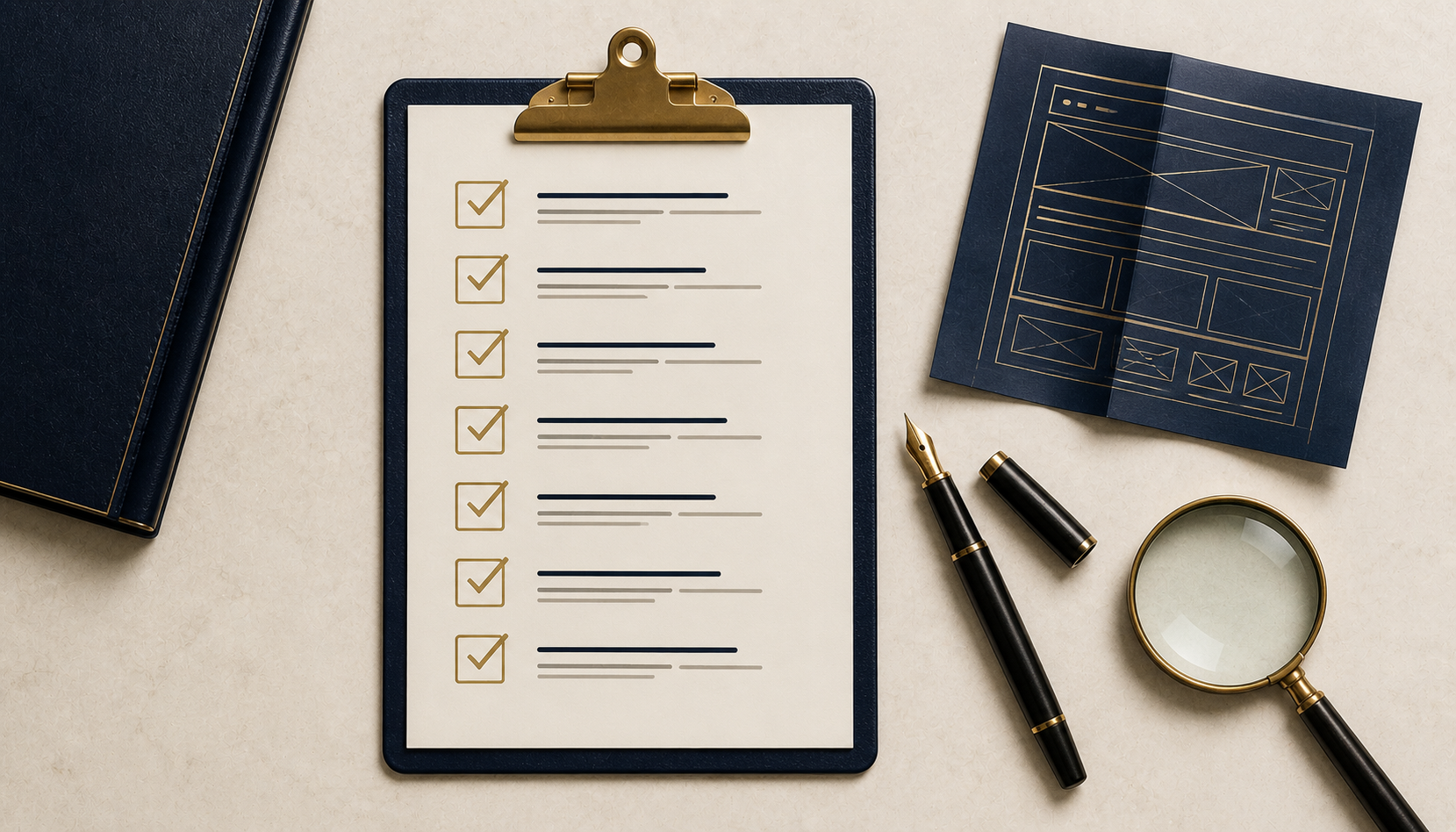
By Ashikur Rahman, LLB, LLM (International Law). The same checklist used internally before pitching every new law firm engagement at Hey Ash. Designed to be runnable in a single afternoon by a non technical user.
Most law firm SEO audits sold by agencies are between 40 and 80 pages long, full of charts pulled from SEMrush, and useless to the firm receiving them. They diagnose without prescribing, and they confuse activity with insight.
This is the audit checklist we actually use internally before pitching a new client. It covers the seven categories that drive almost all law firm ranking outcomes, and you can run it on your own site in a single afternoon. At the end, you will have a clear list of what is broken, what is adequate, and what to fix first.
HOW TO USE THIS CHECKLIST
- Score each item Pass, Fail, or Unknown.
- The total possible score is 75. Most firms in competitive markets score between 35 and 50.
- Fix items in the priority order at the bottom of this post for fastest measurable returns.
- Re run the checklist quarterly to track progress.
- Want it as a printable PDF? Request the free template at the bottom of this post.
Section 1: Technical foundation
Without these in order, nothing else you do will compound. These eleven items are the floor.
- Site loads over HTTPS with a valid certificate
- Largest Contentful Paint under 2.5 seconds on mobile (check in PageSpeed Insights)
- Cumulative Layout Shift under 0.1
- Interaction to Next Paint under 200ms
- XML sitemap exists and is submitted to Google Search Console
- robots.txt does not accidentally block crawling of important sections
- No more than one H1 per page
- All pages are reachable in three clicks or fewer from the homepage
- 404 errors below 1 percent of crawled URLs
- No mixed content warnings in the browser console
- Mobile usability passes Google Search Console without errors
Section 2: Local SEO and Google Business Profile
For most law firms, the map pack is where the highest intent leads come from. This is where most audits find the biggest immediate wins.
- GBP is verified and the primary category is set correctly (e.g. “Personal injury attorney” not just “Lawyer”)
- All applicable secondary categories are filled in
- Business hours are accurate and updated for holidays
- Phone number matches NAP across all directories
- Address is consistent (suite vs. ste., punctuation, etc.) everywhere
- At least 25 reviews, with a 4.5+ average
- Reviews are responded to within 7 days, including critical ones
- Q&A section has been seeded with relevant questions and answers
- Photos uploaded in the last 90 days
- GBP posts published at least monthly
- Service list populated with all practice areas
- Top 50 legal directories list NAP correctly (Avvo, Justia, FindLaw, Lawyers.com, Martindale, Super Lawyers, Yelp, BBB)
If your audit has time for only one section, do this one. The map pack is where the fastest, highest intent leads come from for almost every law firm.
Section 3: On page SEO
- Every page has a unique title tag under 60 characters
- Every page has a unique meta description between 130 and 160 characters
- Title tags include the primary keyword and city or state where appropriate
- H1 matches user intent, not just brand
- Practice area pages are at least 1,200 words and answer the questions a prospect would actually ask
- Internal linking flows from informational content to commercial pages
- Anchor text is descriptive, not “click here”
- Every image has descriptive alt text
- URL structure is short, lowercase, hyphenated, and keyword relevant
- Canonical tags are correct on every page
Section 4: Content and E-E-A-T
This is where YMYL standards are won or lost. Google holds legal content to a higher bar than almost any other vertical. For the full reasoning, see our breakdown of YMYL SEO for lawyers.
- Every blog post is bylined to a specific attorney, not “Admin” or the firm name
- Author bios include bar admissions, school, year, and a real photo
- Person schema markup links author profiles to bar listings, LinkedIn, and Avvo
- Date published and date modified are visible and accurate
- Citations to statutes, regulations, and cases are present where claims are made
- Disclaimers are present but do not appear before substantive content
- Content is updated at least annually for evergreen posts
- Topical clusters exist for at least three practice areas
- FAQ sections are present on practice area pages with FAQ schema
Section 5: Backlinks and authority
- Domain Rating (Ahrefs) or Domain Authority (Moz) tracked monthly
- Referring domains growing month over month
- No spammy or PBN links in the active backlink profile
- Toxic links disavowed where appropriate
- At least 5 inbound links from .edu, .gov, or major legal publications
- Active outreach for guest posts, HARO/Qwoted, and digital PR
- Listed on at least 30 of the top 50 legal directories
Section 6: AI search and schema
The newest section of the audit, and the one where most firms score lowest. Read our full GEO guide for law firms for the underlying framework.
- LegalService schema on homepage and practice area pages
- Attorney schema on every team bio
- FAQ schema on relevant pages
- Article schema on every blog post
- BreadcrumbList schema on interior pages
- Site is crawlable by GPTBot, ClaudeBot, PerplexityBot, and Google-Extended
- Top 10 target queries tested in ChatGPT, Perplexity, and Google AI Overviews with citations logged
- Question led content structure (each H2 or H3 answers a specific question)
Section 7: Conversion and tracking
Rankings without conversions are vanity. This last section is where most audits stop short and where most firms quietly waste their budget.
- GA4 installed and configured with goal events
- Search Console connected and verified
- Call tracking on every page (CallRail or equivalent)
- Form submissions tagged and tracked
- Live chat or chatbot present and monitored
- CTAs above the fold on every commercial page
- Phone number clickable on mobile and visible in the header
- Trust signals visible: bar admissions, awards, case results, reviews
- No more than two CTAs per page (more reduces conversion)
- Bar association advertising rules complied with on every page
How to score yourself
Add up your Pass count across all seven sections. The total possible is 75.
| Score | Diagnosis | Recommended next move |
|---|---|---|
| 65 to 75 | Strong foundation | Focus on content depth and link acquisition |
| 50 to 64 | Solid baseline with meaningful gaps | Most firms in competitive markets sit here. Prioritize the 5 to 10 weakest items. |
| 35 to 49 | Significant work needed | Likely losing leads to better optimized competitors. Start with sections 2 and 1. |
| Below 35 | Not currently competing | SEO investment is being wasted until the foundation is fixed |
What to fix first
If you have found dozens of issues, the temptation is to fix everything at once. Do not. The order that produces the fastest measurable returns:
- Google Business Profile and local citations (fastest impact on lead volume)
- Core Web Vitals and technical foundation
- On page SEO for top 10 commercial pages
- Author E-E-A-T signals and schema
- Question led content restructure for AI search
- Topical cluster expansion
- Backlink acquisition
Frequently asked questions
How long should the full audit take?
Three to four hours for a single location firm with one or two practice areas. Eight hours for a multi location firm. Block the time on a calendar and do not try to fit it around client work.
Do I need any paid tools to run this audit?
No. The audit can be run with free tools alone: Google Search Console, Google Analytics, PageSpeed Insights, the schema.org validator, and Google’s mobile friendly test. Paid tools (Ahrefs, SEMrush) speed up section 5 but are not required.
How often should I re run this audit?
Quarterly. Quicker if you have made significant site changes, slower if your firm is stable and rankings are healthy. Always re run after a Google core update.
Can I have my marketing person run this instead of doing it myself?
Yes, but you should review the results yourself. The audit surfaces strategic decisions that only ownership can make. For example: do we want to compete in this practice area, this location, this price tier?
What if my agency refuses to share their audit findings?
Walk away. Refusal to share diagnostic findings is one of the clearest red flags in the SEO industry. See our full list of red flags in agency proposals.
Get the printable PDF version
If you would rather work through this with your team using a fillable PDF, request the audit checklist as a printable template. We will send it to your inbox along with a short Loom video explaining how we use it on real engagements. No call required, no upsell. Just the checklist.