To get your business cited by ChatGPT and Google AI Overviews, you need three things: crawlers that can reach your pages, pages that answer one question clearly enough to quote, and a presence on the third-party sites those engines already trust. Nobody can promise a citation, and anyone who does is guessing. What you can do is remove every reason an engine has to skip you. This article covers how each engine finds sources, the robots.txt settings that decide whether you are even eligible, how to write a page that gets quoted, why most citations point at other people's sites, what structured data does and does not do, how to measure progress in GA4 and Bing Webmaster Tools, the things that do nothing, and the questions people ask most.
How each engine finds its sources
The engines do not share one index, so it helps to know where each one looks.
- Google AI Overviews and AI Mode draw on Google's normal search index. Google states that there are no extra technical requirements: a page must be indexed and eligible to be shown with a snippet. If a page is not in Google's index, it cannot be a supporting link.
- ChatGPT search uses OpenAI's own crawler, OAI-SearchBot, together with results from third-party search providers. Bing is widely reported to be one of those providers, which is why a clean Bing presence matters for ChatGPT.
- Microsoft Copilot answers come from Bing's index.
- Perplexity runs its own crawler, PerplexityBot, and cites the pages it retrieves for each answer.
So the first practical rule is simple. If you are not indexed in Google and Bing, most AI answers cannot cite you. Check both before you do anything clever.
Step 0: Confirm you are indexed in Google and Bing
Before any AI work, confirm the basics in both search engines. In Google, open Search Console and check Indexing > Pages for your important URLs, or paste a single URL into URL Inspection and read whether it says URL is on Google. In Bing, open Bing Webmaster Tools and use URL Inspection the same way. If you have never added the site to Bing Webmaster Tools, do it now. You can import the site directly from Google Search Console, which takes a few minutes, and then submit your sitemap there.
Google: Search Console > URL Inspection > paste URL > URL is on Google
Bing:   Bing Webmaster Tools > URL Inspection > paste URL > Indexed
Bing:   Bing Webmaster Tools > Sitemaps > Submit sitemap
A quick outside check also helps. Search site:yourdomain.com in Google and in Bing. If Bing returns a handful of pages while Google returns dozens, your ChatGPT and Copilot visibility is limited by Bing, and fixing that is the fastest win available. Bing also supports IndexNow, a protocol that lets a site tell Bing the moment a page changes. Many CMS plugins and hosts support it with a single setting.
Step 1: Make sure the right crawlers can reach you
OpenAI documents three separate crawlers, and they do different jobs. OAI-SearchBot decides whether your site can appear in ChatGPT search answers. GPTBot collects content for training models. ChatGPT-User fetches a page when a person asks ChatGPT to open it. OpenAI's documentation says sites that block OAI-SearchBot will not be shown in ChatGPT search answers. Blocking GPTBot does not remove you from search. Google works the same way in the other direction: the Google-Extended token controls use in Gemini model training, and it does not change whether you appear in Search or AI Overviews, which use Googlebot.
Open your robots.txt at yourdomain.com/robots.txt. If you want to be cited, it should allow the search crawlers. This is the version I use as a starting point:
User-agent: *
Allow: /

# ChatGPT search (citations)
User-agent: OAI-SearchBot
Allow: /

# Perplexity
User-agent: PerplexityBot
Allow: /

# Optional: training crawlers. Allow or disallow as you prefer;
# this does not change search visibility.
User-agent: GPTBot
Allow: /

Sitemap: https://yourdomain.com/sitemap.xml
Then test what your server actually does when each crawler asks. Security plugins and firewalls sometimes block AI crawlers without telling you, and robots.txt says nothing about that. A 403 or a challenge page means the crawler is blocked at the server, whatever robots.txt says:
for ua in "OAI-SearchBot" "PerplexityBot" "bingbot" "Googlebot"; do
  printf "%-15s " "$ua"
  curl -s -o /dev/null -w "%{http_code}\n" -A "$ua" https://yourdomain.com/
done
Some sites blocked every AI crawler in 2024 out of caution and never undid it. If yours did, that single file explains why ChatGPT never names you. OpenAI says changes to robots.txt take about a day to reach its search systems.
Step 2: Write pages that answer one question well
AI engines quote short passages that answer the prompt directly. The pages I see quoted most often open with the answer and then back it up. A question about price gets a price range in the first two lines. A question about which option is best names the options and says who each one suits. A page that spends three paragraphs on background before it answers gets skipped.
- Put the direct answer in the first two sentences under each heading.
- Write headings the way people phrase the question, for example How much does a crown cost in Austin, not Our pricing.
- Add specifics a model cannot invent: prices, service areas, opening hours, numbers, dates, names of the people doing the work.
- Use a comparison table where buyers compare options. Tables are easy to lift into an answer.
- Keep your business facts identical everywhere: name, address, phone, services and prices should match across your site, your Google Business Profile and your directory listings.
One structural point matters more than people expect. Make the content available in the HTML the server sends, not only after JavaScript runs. Several AI crawlers do not render JavaScript. If your page source is an empty container, those crawlers see an empty page.
Step 3: Most citations come from other people's sites
This is the part most businesses miss. For many questions, the engine cites roundups, directories, review sites and forum threads rather than the business's own page. One 2026 study by DerivateX ran buyer prompts for 40 B2B software categories through ChatGPT and found that only 11.6% of citations pointed at the recommended tool's own site. In 25 of the 40 categories, the tool's own site was not cited at all.
So the work splits in two. On-site work makes your own pages quotable. Off-site work gets you onto the pages the engines already quote. The method for the second half is plain:
- Write down the 10 to 20 questions a buyer asks before choosing a business like yours.
- Run each one in ChatGPT with search on, in Perplexity, and in Google, and record every page they cite.
- Group the cited pages: directories, roundups, review sites, forums, news.
- Get listed in the directories, ask to be included in the roundups, and make your profiles on those sites complete and accurate.
- For local businesses, treat your Google Business Profile and its reviews as part of this list. Local answers lean on them heavily.
Step 4: Use structured data to remove guesswork
Structured data tells search engines exactly who you are and what you offer. I add it on every project because it removes ambiguity: the business type, the services, the people, and sameAs links to your real profiles elsewhere. Serve it in the HTML, not injected later by a script. This is a trimmed example for a local business:
<script type="application/ld+json">
{
  "@context": "https://schema.org",
  "@type": "Dentist",
  "name": "Example Dental Studio",
  "url": "https://exampledental.com/",
  "telephone": "+1-512-555-0100",
  "address": {
    "@type": "PostalAddress",
    "streetAddress": "100 Main St",
    "addressLocality": "Austin",
    "addressRegion": "TX",
    "postalCode": "78701"
  },
  "sameAs": [
    "https://www.facebook.com/exampledental",
    "https://www.yelp.com/biz/example-dental-austin"
  ]
}
</script>
Structured data will not earn a citation for a page that does not answer the question. FAQ rich results have also been limited to well-known government and health sites since 2023, so use FAQ markup for clarity, not for a snippet you will not get.
Step 5: Measure it
AI visibility is measurable if you look in the right three places.
GA4 referrals
In GA4, open Reports > Acquisition > Traffic acquisition and change the dimension to Session source. For a cleaner view, build an exploration with a filter on session source that matches this regular expression:
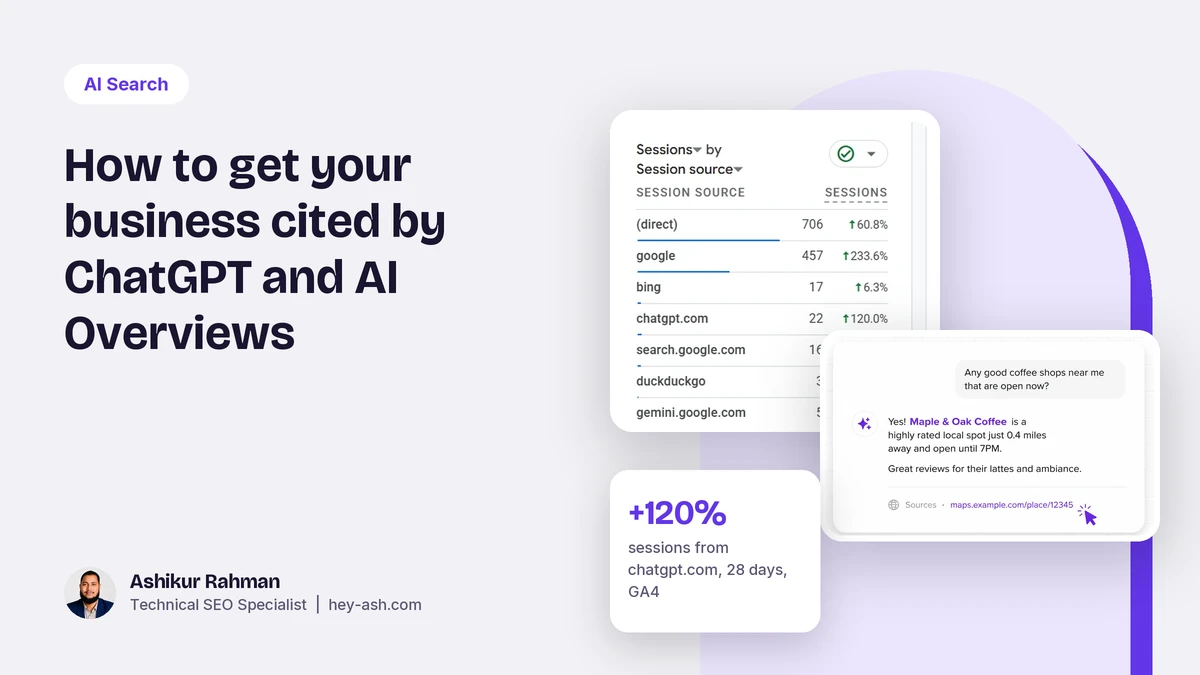
chatgpt\.com|chat\.openai\.com|perplexity\.ai|copilot\.microsoft\.com|gemini\.google\.comOn one client site, this is the report I read. Sessions from chatgpt.com were up 120% in a 28-day comparison, while Google sessions rose 233.6% in the same window. The AI number is still small next to Google, and that is normal. What matters is the trend.

Bing Webmaster Tools AI Performance
Bing added an AI Performance report to Webmaster Tools as a public preview in early 2026. It shows how often Copilot and Bing's AI answers cite your pages and for which queries. It does not include clicks, and it does not cover ChatGPT, but it is the only first-party citation count most sites can get today.
Monthly prompt tests
Ask the same 10 to 20 buyer questions every month in a fresh chat and log who gets named. Answers vary from run to run, so run each question more than once and watch the trend rather than one reply. A plain sheet is enough:
date,engine,question,run,your_site_cited,competitors_cited,sources_cited
2026-10-31,ChatGPT,best emergency dentist in austin,1,no,"A; B","yelp.com; example-roundup.com"
What does nothing
- An llms.txt file on its own. It is cheap to add and I add one, but no major engine has confirmed it uses the file to choose citations.
- Stuffing pages with the words ChatGPT or AI. Engines quote answers, not mentions of themselves.
- Buying a tool that promises to submit your site to ChatGPT. There is no submission form.
- Rewriting every page in a question and answer format. One clear answer under a clear heading is enough.
- Blocking GPTBot and expecting it to change citations. GPTBot is the training crawler, so blocking it neither helps nor hurts search visibility. Blocking OAI-SearchBot by mistake is what removes you, so check which one your file names.
Questions people also ask
How do I get my business mentioned by ChatGPT?
Allow OAI-SearchBot in robots.txt, make sure you are indexed in Bing and Google, write pages that answer buyer questions in the first lines, and get listed on the directories and roundups ChatGPT already cites for your questions. Then measure it with monthly prompt tests and GA4 referrals.
How do I rank in ChatGPT search results?
There is no ranking position to buy or submit. ChatGPT search picks sources that answer the prompt and that it trusts. Clear answers, consistent business facts, a strong Bing presence and mentions on third-party sites are what move it.
How does ChatGPT choose its sources?
ChatGPT search combines results from its own crawler and third-party search providers, then cites pages that answer the question directly. Pages with specific facts near the top, and sites that other trusted pages mention, are cited more often.
Does ChatGPT use Bing or Google?
OpenAI says ChatGPT search uses third-party search providers as well as its own crawler, and Bing is widely reported to be one of them. Google's index powers Google's own AI Overviews, not ChatGPT.
How do I get into Google AI Overviews?
There is no special markup. A page must be indexed and eligible to show a snippet. After that, pages that answer the query directly, with clear headings and specific facts, are the ones Google links as sources.
Want to know what AI says about you?
Send me your URL and three questions your customers ask. I will run them through the main engines and tell you who gets cited and why. You can hire me for the work on Upwork.
Related reading: what crawled, currently not indexed means, Google Business Profile checks when calls drop, and the full AI search optimization (AEO and GEO) service.